Robotics · · 4 min read
One AI Brain Teaches a Simulated Humanoid to Walk, Grab and Carry
In a computer simulation, researchers trained one controller to handle nine everyday objects.
 By Michael Perry · Researched and drafted with Jules, Kineticly’s AI research desk.
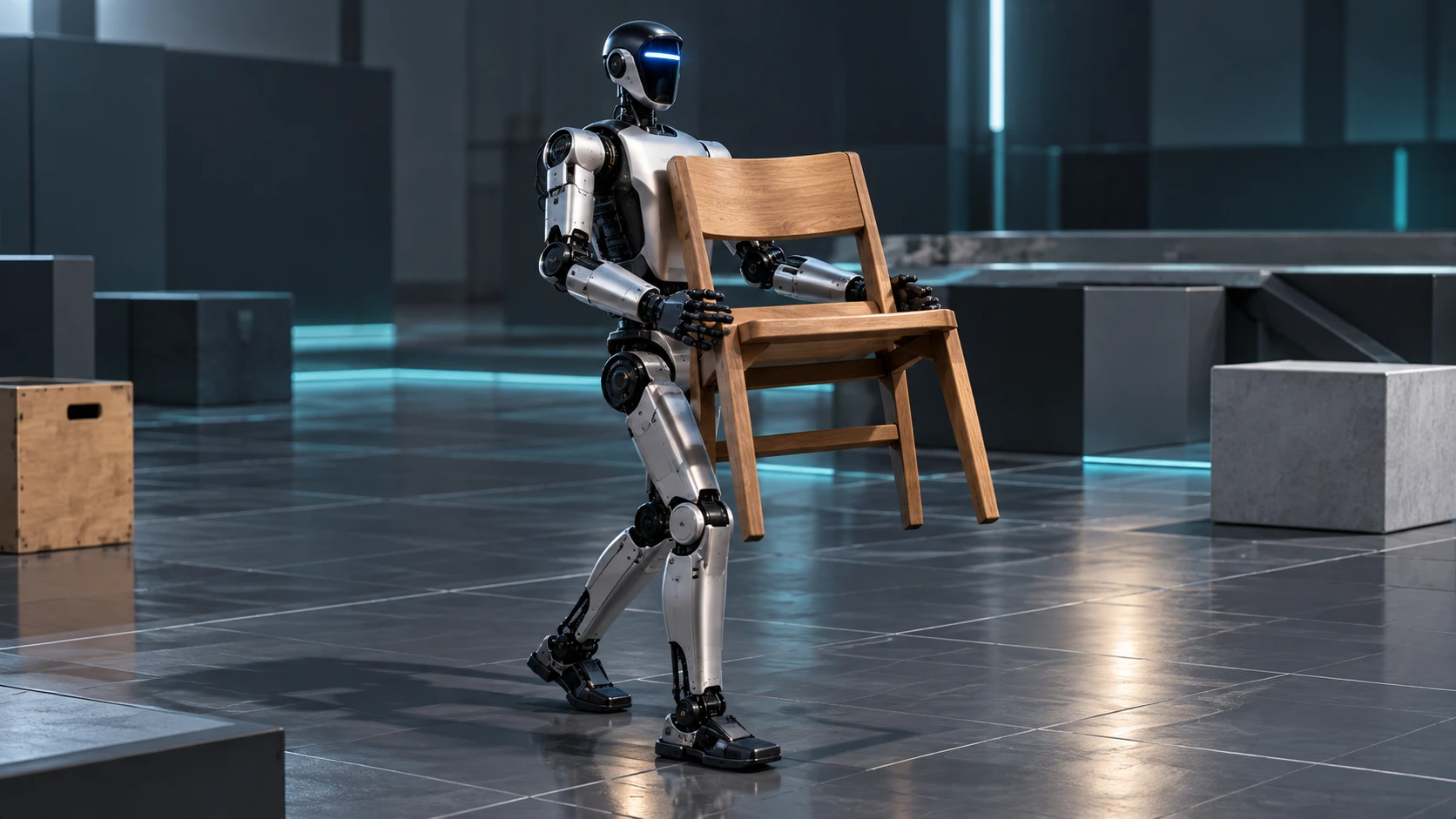
Moving a chair looks effortless: walk over, grab it, shift your weight under the load and carry it off. For a humanoid robot, that errand means solving balance, walking, gripping and carrying all at once.
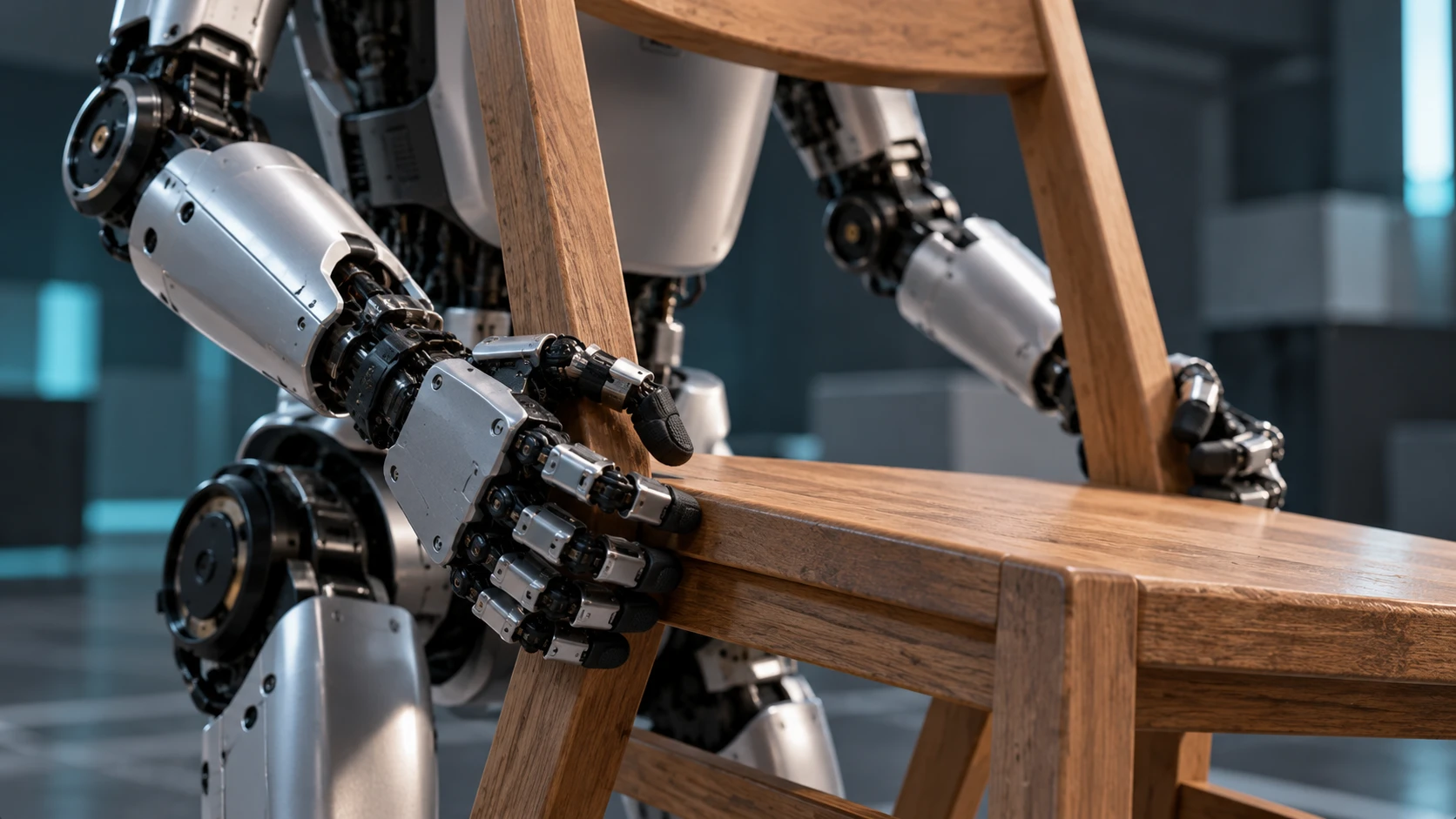
A team from Tsinghua University, Dalian University of Technology and the Chinese University of Hong Kong now reports a system called Weave that teaches a simulated humanoid to do exactly that: walk up to an everyday object such as a chair, box or table, grip it with multi-fingered hands and carry it to a target spot S1. What sets it apart is that one learned controller combines all three skills, whole-body movement, finger-by-finger grip and interactions with nine different objects, rather than splitting them up S1.
Why was this so hard?
Every part of the job affects every other part. A slightly wrong grip changes the forces on the robot's upper body, and a clumsy step can topple both the robot and what it's holding S1. The robot's legs and torso have to manage balance on the slow rhythm of walking, while its fingers need to land within millimeters to hold on S1.
Copying people isn't enough: a robot is built differently, so matching a person's pose doesn't guarantee it can bear the weight S1. Many earlier approaches ignored finger contact or trained one controller per object or motion clip S1.
How does it work?
The team started with motion-capture recordings of people handling everyday objects S1. Weave works in two stages.
First, it adapts each human recording to the robot's different proportions and joints, keeping the moments where the hands touch the object S1. Because the recordings begin mid-task, a motion-generation model adds the walk up to the object S1.
Second, a single controller learns by trial and error in a physics simulation, rewarded for closely following those reference motions of both robot and object, with the object's shape as one of its inputs S1.
What do the results show?
On the tasks it trained on, the controller succeeded 92.5 percent of the time, roughly 37 of every 40 attempts S1. On new motion sequences for the same nine objects, which it had never practiced, it succeeded 65 percent of the time without any extra training: still promising, but a real drop S1.
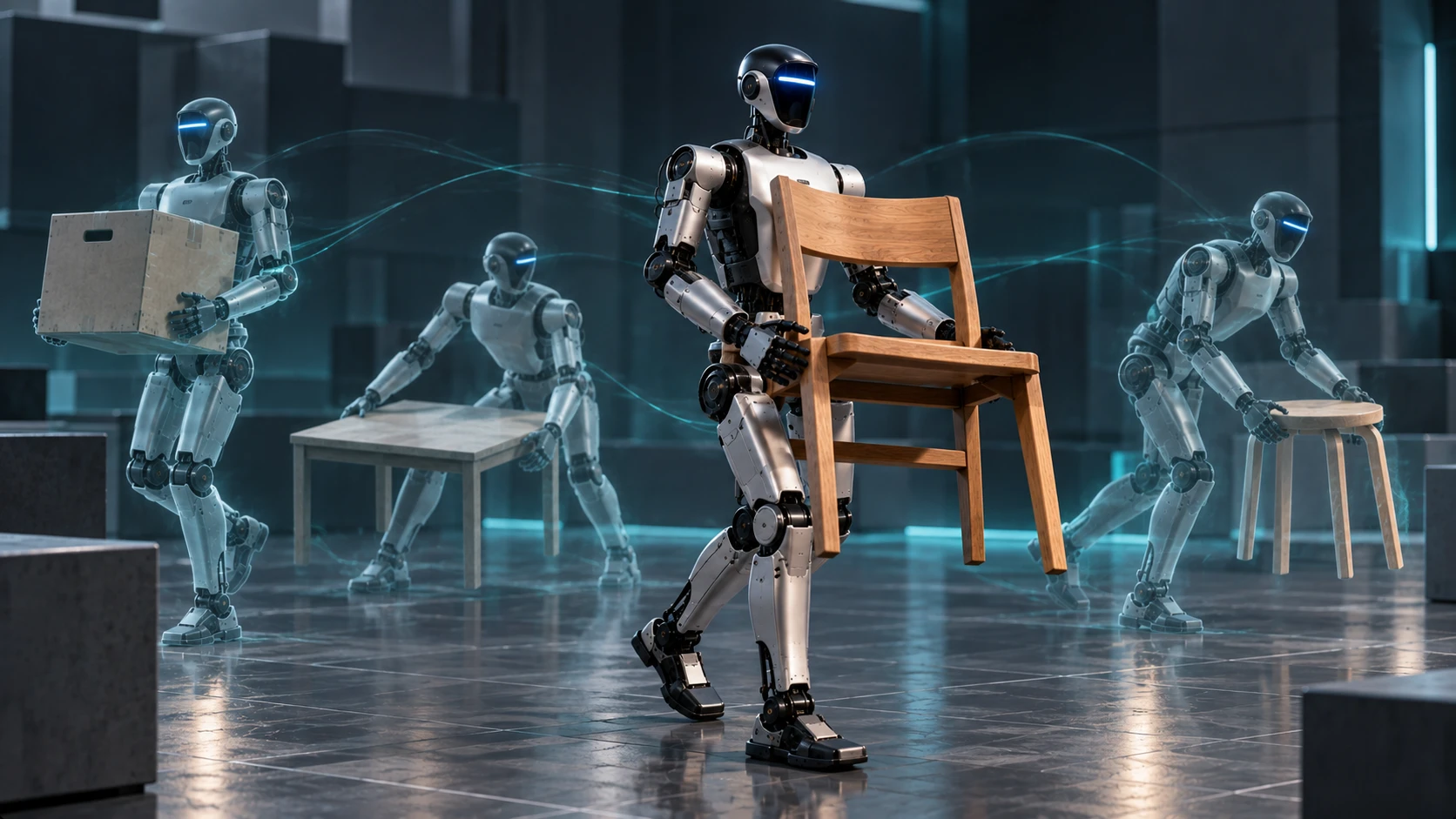
The most interesting result is a head-to-head comparison. The researchers trained one shared controller on all nine objects and, separately, nine specialists, one per object, with the same total amount of training S1. The shared controller finished more tasks overall, 95.3 percent against 91.5 percent, matching the specialists on three objects and beating them on six; both were scored on the motions they had trained on S1.
The specialists often copied the reference motions more precisely yet completed fewer tasks S1. The authors' explanation: walking, balancing and carrying look alike across objects, and similar shapes, such as small and large tables, are gripped alike, so practice on one object helps with the others S1. Faithful imitation, they conclude, isn't the same as getting the job done S1.
Why does it matter?
Humanoid robots are meant to work in places built for people, where everyday tasks mean approaching, grasping and moving objects while staying upright S1. A single controller that learns many such interactions together, rather than one at a time, is a step toward robots that could one day take on chores in homes, offices or warehouses: picking up a box, stepping around a chair and setting the box on a shelf. That is a possibility, not something Weave has shown; this study demonstrates the approach only in simulation.
Nearer term, the team released about 9,000 simulated runs, roughly 23 hours, for other researchers to build on S1.
What it hasn't shown yet
The results come from a single preprint, posted to arXiv on September 15, 2026, that hasn't yet been peer reviewed or repeated by another lab, and everything happened in simulation. The controller was given perfect information about where the robot and the object were, something a real robot would have to work out from its own cameras and sensors, and the gap between simulation and the real world was not tested S1.
The robot also can't decide what to do on its own: it performs an interaction only when given a reference motion to follow, and heavy or highly articulated objects were outside its training S1. The 65 percent result shows that new situations remain hard. Next, the authors say, come real-world sensing and a higher-level planner that chooses which interactions to perform S1.
Editor's Perspective
What I find most exciting about this research isn't necessarily the success rate, but the idea of teaching a robot skills it can apply across different tasks. If humanoid robots are ever going to become practical in everyday life, they can't need a completely separate program for every object they encounter. There's obviously still a long way to go before this works reliably in the real world, but I think research like this is an important step toward robots that can adapt to their surroundings rather than just repeat specific movements.
Sources
- S1 Cao, Wu, Cui, Xu, Pei, Chen and Xu. "Weave: Learning Whole-Body Dexterous Loco-Manipulation from Human–Object Interactions." arXiv preprint 2609.16683, submitted September 15, 2026.