Physics · · 7 min read
Scientists say they made a single molecule glow its purest possible color, out in the open on a surface
A crystal-peeling trick gives single molecules a quiet place to glow.
 By Michael Perry · Researched and drafted with Jules, Kineticly’s AI research desk.
How we know this: from the researchers' preprint and their institute's announcement, as republished by ScienceDaily. The final published paper wasn't reviewed for this article, and no other lab has repeated the result yet. The institute calls the surface "ultra-clean," but its cleanliness was not measured directly.
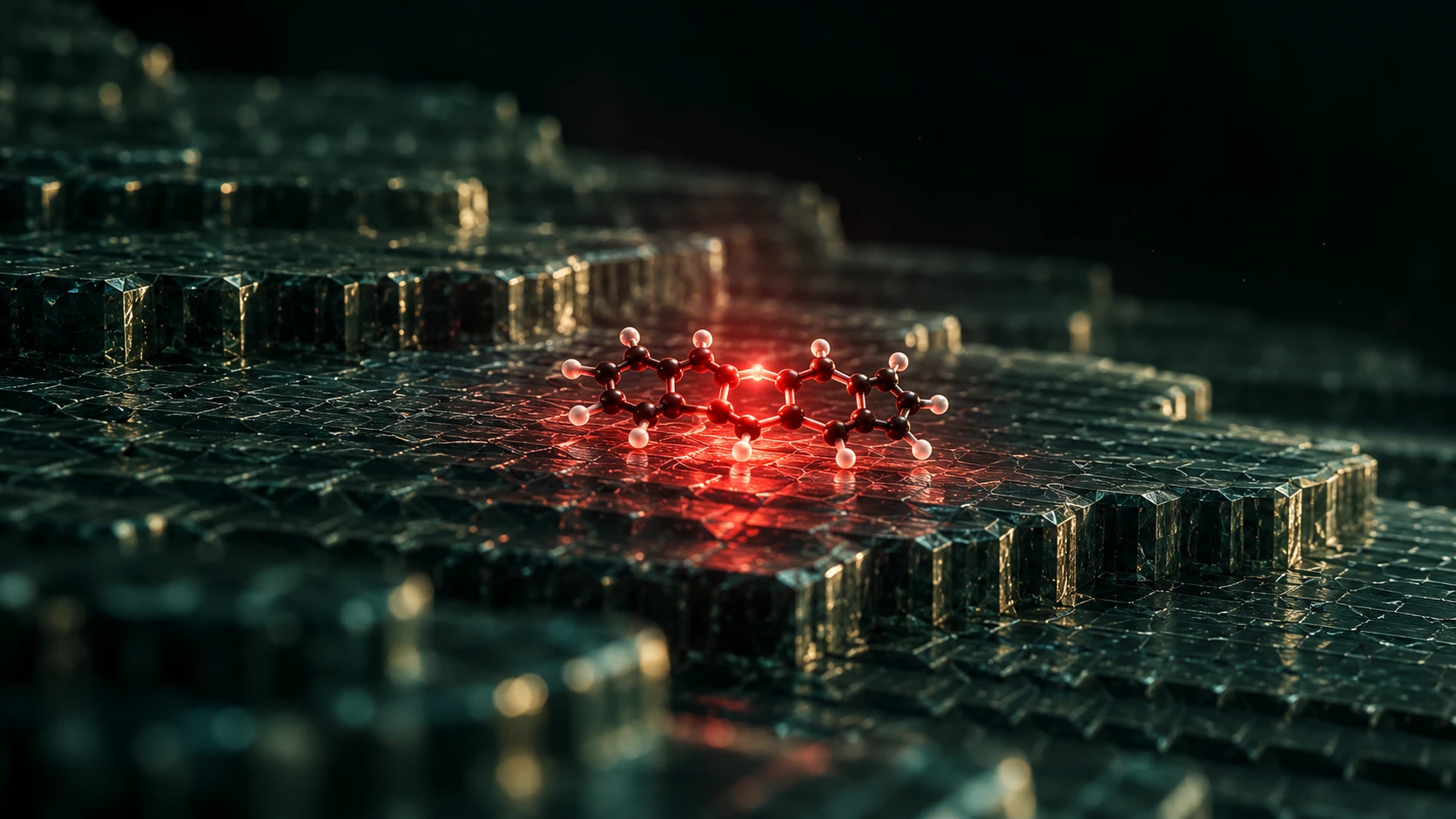
Strike a tuning fork in a silent room and you hear one clean, pure note. Strike it at a rock concert and the note is still there, but the noise smears it until you can barely pick it out.
Molecules have the same problem with light: each glows in its own precise color, and noise smears it. Physicists at the Max Planck Institute for the Science of Light in Germany, in a team led by Vahid Sandoghdar, report that they have kept single dye molecules so undisturbed, while sitting exposed on a surface, that they can glow at the purest color nature allows. The researchers confirmed that limit directly for one molecule, and thousands of others showed similarly narrow glows. S1 The institute says it is the first time anyone has reached that limit with molecules attached to a surface. S2
Why was this so hard?
Here, a surface means the outermost layer of a solid, where the material ends and empty space begins. A molecule "on a surface" rests on that last layer, like a marble on top of a glass block rather than sealed inside it.
That exposure is what scientists want. Glowing molecules are usually studied trapped in a vacuum or embedded inside a solid, the institute explains, but one sitting on the outside could be touched or moved with the needle-sharp tips of scanning tunneling and atomic force microscopes, which already work at the scale of single atoms. S2
The catch is that stray particles settle on surfaces and jostle anything there, which can make a molecule's delicate quantum behavior fade hundreds or even thousands of times faster than nature's limit allows, according to the institute. S2 In the researchers' words, earlier studies of molecules on surfaces "have fallen short of the ultimate resolution." S1
How does it actually work?
The trick is a bit like peeling an apple and taking a bite before it has a chance to brown.
The team starts with crystals of anthracene, an organic compound, grown on a glass slide and a few tens of micrometers, or hundredths of a millimeter, thick. S1 Crystals like this slowly evaporate straight from solid to gas. S2 Sealed in a vacuum chamber built for extreme cold, the crystal's top layers evaporate away over about three hours, at a few thousandths of a millimeter per hour, as the sample cools to just below freezing. S1 As those layers leave, the institute explains, they carry unwanted contaminants away with them. S2
What's left is a brand-new surface of flat terraces separated by steps one molecule high, as microscope scans confirmed. Once the chamber is cooled close to absolute zero, almost nothing can evaporate onto it, so it stays protected. S1

Then comes the dye. (Kelvin is a temperature scale that starts at absolute zero, the coldest possible temperature, and climbs in steps the same size as Celsius degrees.) A tiny oven on a chip, a fine platinum wire on glass dusted with a dye called dibenzoterrylene (DBT), was heated for one minute to about 450 kelvin, or about 177 degrees Celsius, while the crystal stayed below 6 degrees above absolute zero. Dye molecules drifted onto the fresh surface, and the setup was cooled to 20 millikelvin, two hundredths of a degree above absolute zero. S1
The apple comparison stops there: the point is not to eat what's underneath but to give the dye somewhere clean to land.
How big an improvement is this?
Some general physics first. Any molecule holds a laser's energy only briefly before releasing it as light, and that brief moment sets a floor on how pure its color can be. Physicists call that floor the Fourier limit, and a "Fourier-limited" glow has hit it. The purity is measured as the width of the glow's color in megahertz, a unit of frequency: the smaller the number, the purer the color.
The preprint checks this directly. One molecule held its energy for 6.9 billionths of a second, and its glow was 23 megahertz wide, the width that lifetime predicts. Its light also came out one particle at a time, the telltale sign of a single, lone molecule. S1
The other numbers back it up:
- Sharper than in the bulk crystal. One molecule's glow, at a wavelength of 720 nanometers, was 18 megahertz wide, narrower than the 27 to 40 megahertz that earlier studies reported for the same dye mixed into the bulk of an anthracene crystal. S1
- Narrow across the board. Across about 10,000 molecules, the typical glow was 19 megahertz wide. By our own arithmetic from the preprint's numbers, that is less than five parts in a hundred million of the light's own frequency. S1
- Neatly arranged. The molecules settle into a handful of preferred spots, and the spread of colors within each is about half that reported for the same dye in the bulk crystal and roughly a hundred times narrower than one recently reported measurement of a different kind of molecule on a surface, which the preprint cites for comparison. S1
- Steady. In the best cases, under gentle light, a molecule's color drifted by only a tenth of its width over several hours, and three of the preferred spots stayed stable for months. S1
What could this become?
The realistic near-term payoff is a new kind of experiment, where scientists see, in fine detail, both where a molecule sits and what color it glows. S1 According to the institute, the team has also seen the crystal line molecules up and shift their energy. S2
Next, Sandoghdar says, the team will combine the method with atomic force and scanning tunneling microscopes "to gain local nanometer control over individual quantum emitters," reaching in to position or tune one molecule at a time. S2
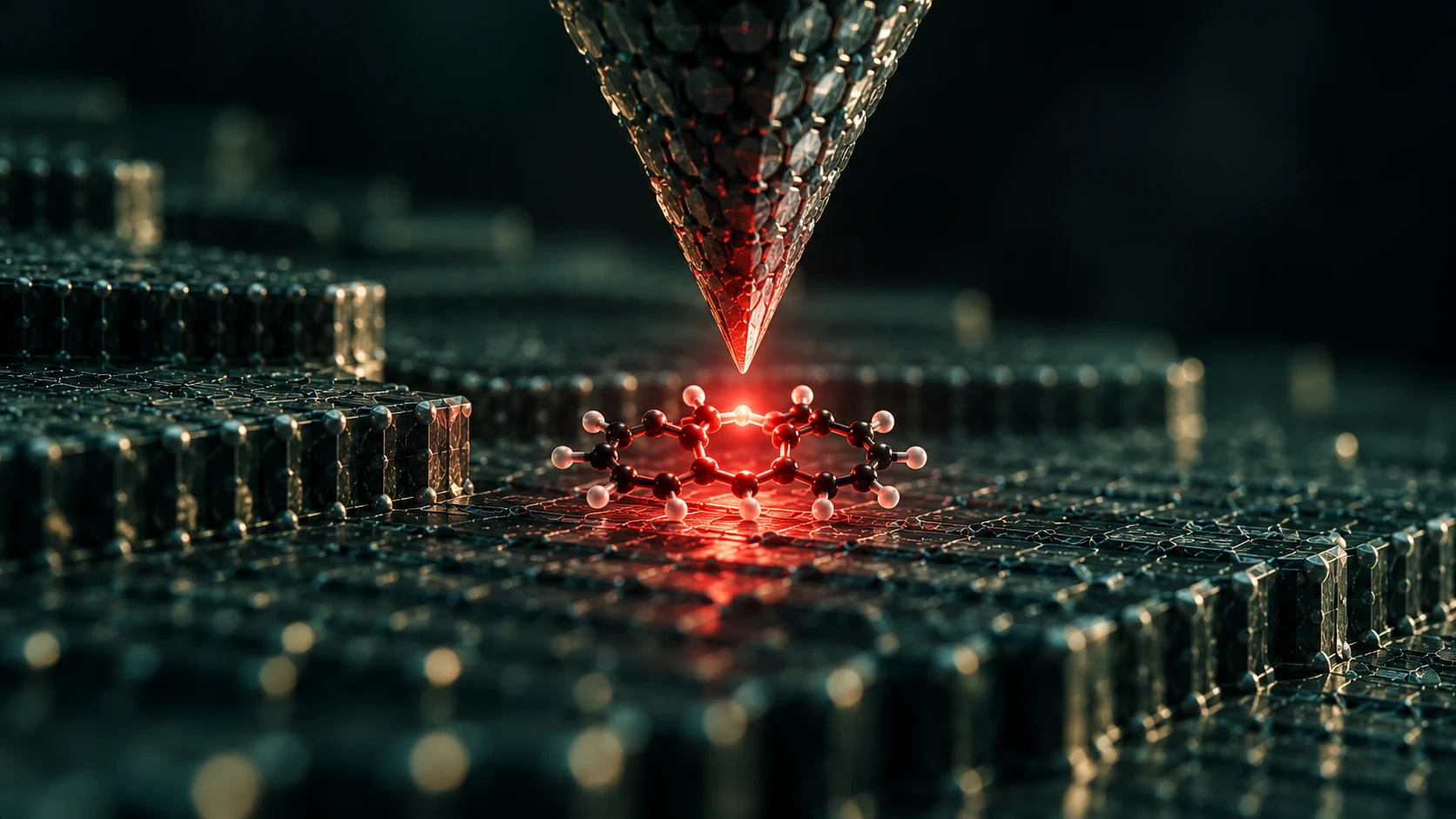
The longer-term prize is quantum technology. Tiny light sources like these can release light one particle at a time, store quantum information, and link distant systems, capabilities that matter for future quantum computers and secure communication, the institute explains. S2 Quantum computers are hoped to one day solve problems today's machines can't, and quantum communication is designed to expose eavesdroppers. These are possibilities, not products.
What's holding it back?
This is a laboratory demonstration, not a usable technology.
- Narrow conditions. It has been shown only for one dye, DBT, on one kind of crystal, anthracene, at liquid-helium temperatures and below. Whether it works for other molecules, other surfaces or warmer conditions has not been shown. It also needs gentle light: stronger light made the colors jump, and some preferred spots disappeared after several days. S1
- How clean is "clean"? The announcement calls the surface "ultra-clean," but the researchers say they could not measure its cleanliness directly. S1S2
- Fine print on the numbers. The 18 megahertz line has no stated margin of error. The lifetime check was made on a different molecule, so it is not known whether the 18 megahertz line itself sits at the Fourier limit, and the preprint does not report what fraction of all the molecules reach it. The preprint describes its measurements as made at liquid-helium temperature, while its methods describe cooling further, to 20 millikelvin, and it does not say which of these temperatures each reported width was measured at. S1
- The "first" claim comes from the institute; the preprint says only that earlier studies fell short. S1S2
- Which version. The announcement says the work was published in Science, but neither that paper nor the institute's original release was reviewed for this article. It relied on the earlier preprint, matched to the paper by title and authors, and on ScienceDaily's republication of the release. The copy of the preprint available for this article was cut off partway, so its full methods and results were not reviewed, and the published numbers could differ. S1S2
What's next
Watch for the published paper's final numbers, whether other labs reproduce them, whether other molecules and surfaces work, and the experiment the surface was built for: a microscope tip controlling one quiet molecule at the scale of a nanometer, a billionth of a meter. S2
Editor's Perspective
When people picture quantum technology, they picture giant machines and exotic hardware. This result is a good reminder that a lot of progress starts much smaller, with someone figuring out how to give a single molecule a quiet place to sit. The fact that the exposed molecules glowed more sharply than the same dye in the bulk crystal makes me think surfaces have been underrated, not just difficult. If the team can bring a microscope tip in close without spoiling that quiet, this could turn into a new way to work with matter one molecule at a time.
Sources
- S1 Mirzaei, Shkarin, et al., "Nano-electronvolt Fourier-limited transition of a single surface-adsorbed molecule," arXiv preprint, first version (primary).
- S2 "Scientists reach the ultimate quantum limit on a surface," ScienceDaily, October 19, 2026, reproducing a release from the Max Planck Institute for the Science of Light (secondary).